Recovery Isn't Complicated. We've Just Made It That Way.
Every few months, endurance sports finds its next miracle recovery tool. As an athlete who grew up in the age of iPhones, instant messaging, and, well, instant-gratification - the concept of miracle recovery tools has been quite prevalent for 2000s kids in the last 5-10 years.
Broccoli shots. Cold plunges. Red light therapy. The latest antioxidant.
Some new supplement everyone swears shaved two days off their recovery.
And honestly - I love new science. I think it's become somewhat part of my brand on @triathletebenny and the way I race.
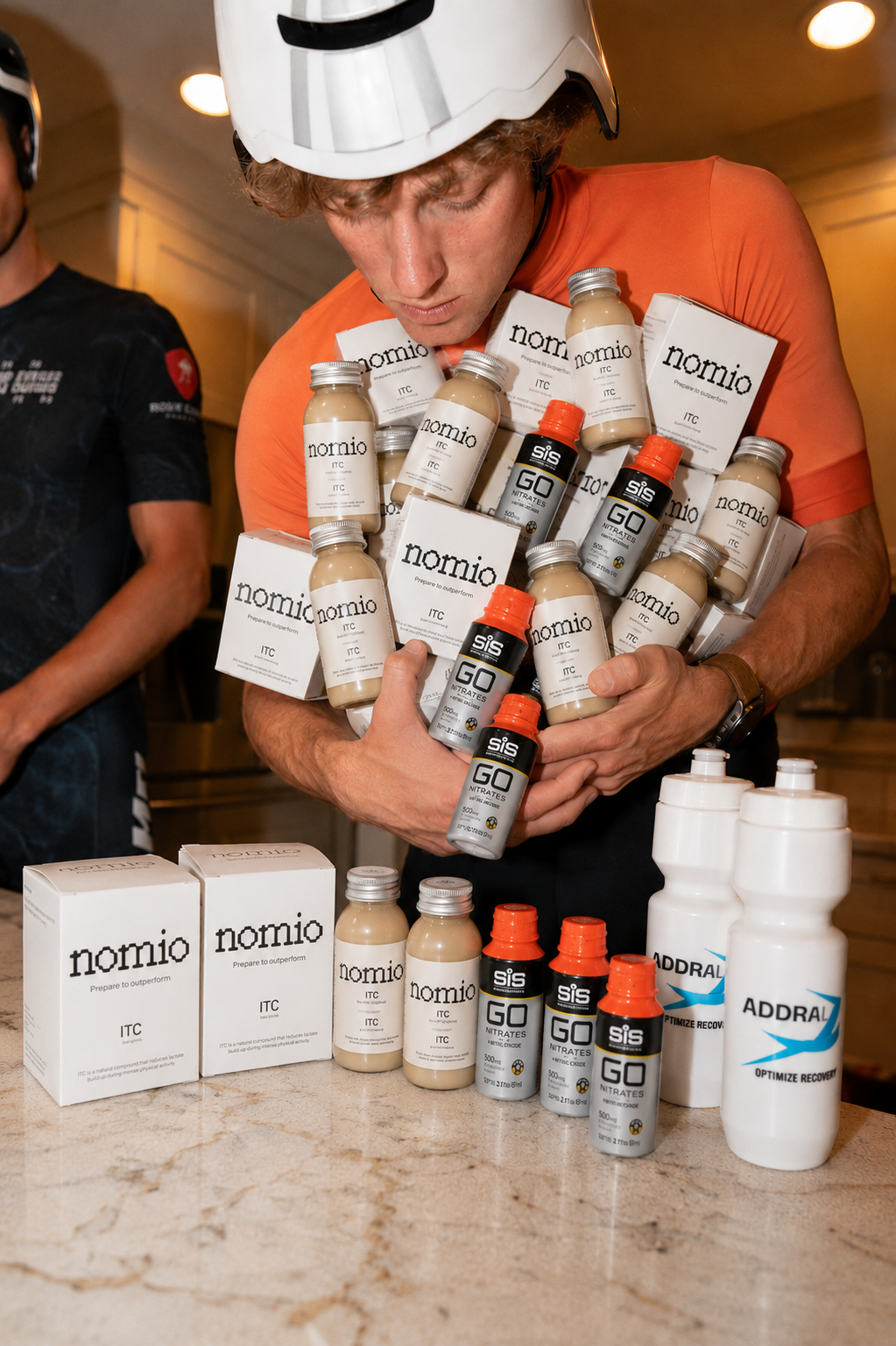
As both a professional triathlete and someone who genuinely enjoys reading sports nutrition research (which has made my partnership with Addra Labs and Matt and Eric quite a great time, I must say!), I'm always excited when something promising comes along.
But there's a problem.
Most athletes are spending all of their mental energy worrying about the top of the pyramid while completely ignoring the bottom.
The reality of this pyramidization is simple:
Recovery isn't built on hacks. It's built on habits.
That's why I love this recovery pyramid and the posts Eric made on all of this last week (see those here). Instead of ranking recovery tools by popularity, it ranks them by something much more important: How much evidence actually supports them.
The Foundation: Nutrition Wins Every Time
Eric here - chiming in on nutrition and sleep, pieces of this pyramid puzzle Benny is quite familiar with in his 30+ hour training weeks; if your nutrition isn't dialed, almost nothing else matters.
No supplement can compensate for consistently under-eating after training, or putting too much of the wrong stuff (at the wrong time) in your body.
The research is remarkably consistent here.
Protein
Aim for roughly 1.8 grams per kilogram of body weight each day.
Protein provides the amino acids your muscles need to repair damaged tissue, rebuild stronger fibers, and adapt to training.
Recovery doesn't happen without it.
Carbohydrates
The first few hours after training matter.
A good target is around 1 gram per kilogram of body weight per hour during the first four hours following a demanding session.
Why?
Because carbohydrates replenish glycogen—the fuel your muscles just spent.
The faster you restore glycogen, the better prepared you are for tomorrow's workout.
Fluids
Hydration isn't simply replacing what you lost.
Most sports nutrition guidelines recommend replacing approximately 150% of fluid losses over the next four to six hours.
That accounts for the continued production of urine while your body returns to normal hydration.
Simple. Not flashy, but ridiculously effective.
The Free Recovery Tools Everyone Has Access To
Once nutrition is handled, we move to the next layer.
Sleep
Nothing comes remotely close.
Sleep drives hormone regulation, tissue repair, immune function, cognitive recovery, and countless other adaptations. It's still the greatest recovery intervention we have.
Naps
Didn't sleep well?
A short nap can meaningfully reduce some of the performance losses from poor overnight sleep.
It's not a replacement, but it's a fantastic backup plan.
Sauna
This one has become one of Benny's favorites, and has helped him quite a bit through some of the hottest off-the-bike runs of the modern Ironman 70.3 age - seeing him consistently dip into the 1:08 and 1:07 ranges for half-marathons in Oceanside, Chattanooga, Happy Valley, and Boise.
Beyond simply feeling good, consistent sauna use has been shown to increase plasma volume - a major advantage for endurance athletes by improving cardiovascular efficiency and heat tolerance.
Recovery and adaptation aren't always separate things.
The Technique Tier
These tools absolutely have value, but are often misunderstood.
Massage
Massage doesn't magically speed muscle repair.
But it does consistently reduce perceived soreness and can leave athletes feeling better and more prepared to train. Sometimes feeling better is enough.
Cold Plunges
Ice baths work, just probably not in the way social media suggests.
The best evidence supports cold water immersion for reducing soreness during the first 24 hours after hard training or racing.
One caveat:
If your goal is maximizing strength or muscle growth, frequent post-workout cold exposure may slightly blunt some long-term adaptations.
Like everything else in sports science: context matters.
The Hype Tier
Here's where things get interesting, not because these products don't work, but because the evidence is still growing.
Tart Cherry
Probably the strongest player in this category. Multiple studies suggest tart cherry can reduce soreness and improve recovery after demanding exercise.
Curcumin
Very promising. Its anti-inflammatory properties make biological sense, and the research continues to improve. We're just not at the same level of evidence as protein, carbohydrates, or sleep.
Broccoli Shots
They're exciting.
They're new.
They're intriguing - yes, Benny is breathing down the back of my neck as I write this, just waiting for me to say they're not worthwhile. I'm not going to say that, but...
They're new.
Maybe they'll become a staple one day, and maybe they won't.
Science deserves time. Period.
The Rule WE Try to Live By
Benny and Eric here -
The wider the tier...the stronger the evidence.
The bigger the effect sizes, and the less hype.
The more promising, but also the more questions remain.
As athletes, it's easy to chase the newest thing because it's exciting. It's much harder to consistently eat enough after training.
To prioritize sleep.
To hydrate properly.
To recover well every single day.
Ironically, those "boring" habits are still responsible for most of the performance gains.
My Take as a Professional Triathlete
I race professionally, and train anywhere from 20 to 35 hours most weeks, depending upon where I'm at in a race-block or build.
If anyone has an incentive to chase every recovery advantage imaginable, it's me. Trust me. Especially given my lack of prowess in the swim - much of my time in this sport is spent hunting. Chasing.
And yet, I've learned something over the years: the athletes who recover best usually aren't doing the craziest things. I'm thinking of the staples of this sport. Jackie Hering. Sam Appleton. Paula Findlay. Matt Hanson. These are all pros who keep their socials relatively quiet, keep things incredibly simple, yet perform at the highest level, time and time again.
They're doing the simple things incredibly consistently.
They eat enough.
They sleep enough.
They hydrate well.
Then—and only then—they start experimenting with the supplements and recovery modalities that might provide another one or two percent.
That's exactly how I think athletes should approach recovery: build the foundation first, and then everything else stacks on top of it.