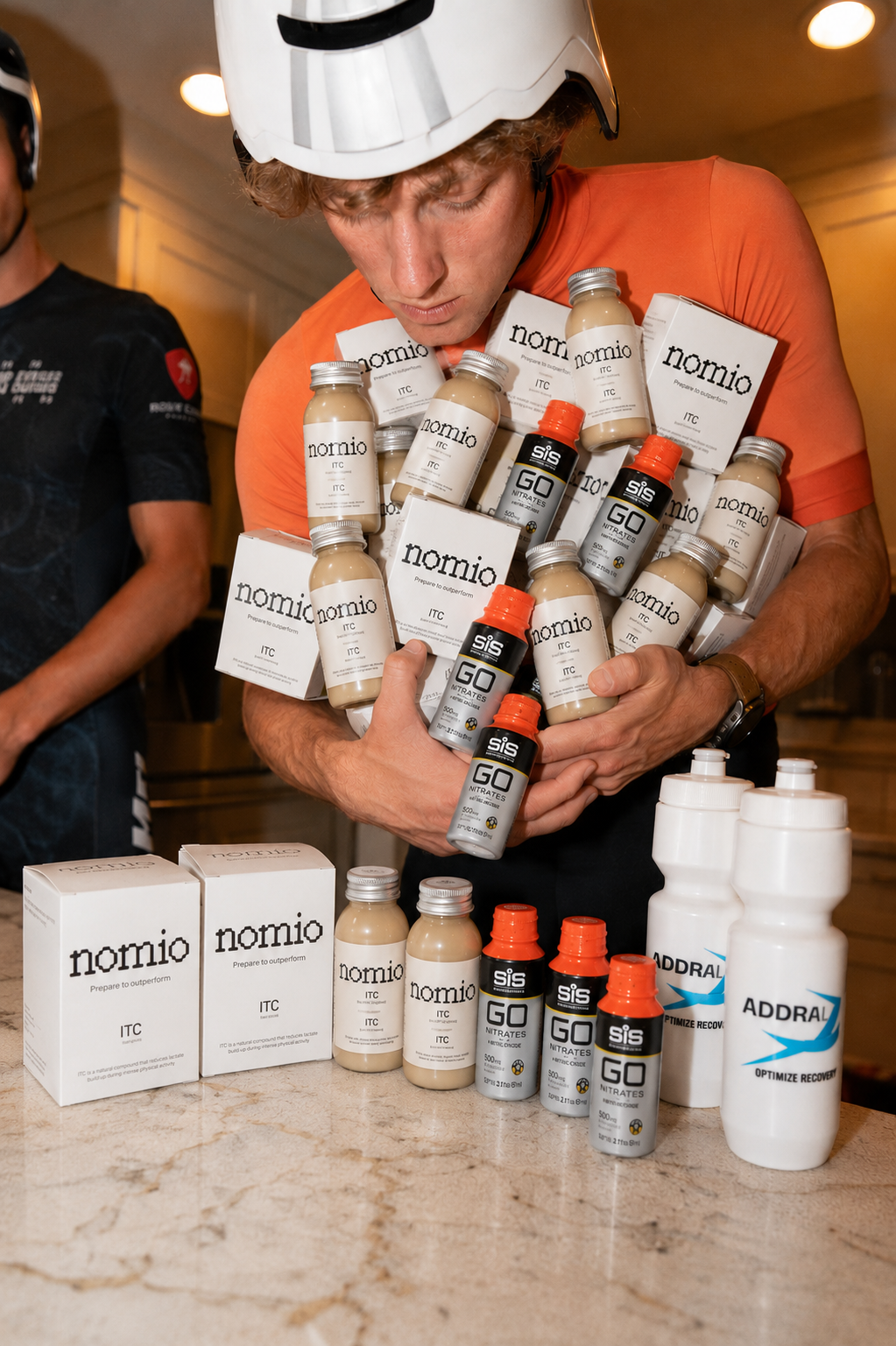
A collaboration between Eric Zaltas & Professional Triathlete, Ben Randall
So...what does "nail the basics" actually mean?
Last week, we introduced the Recovery Pyramid.
The response was, honestly, awesome. It sparked a lot of good conversations, and one question kept popping up:
"Okay...but what does the foundation actually look like?"
Fair question! It's easy to tell athletes to "focus on nutrition."
It's much harder to explain exactly what that means after a two-hour ride, a long run in July, or a double-session training day. So this week, we're zooming in on the widest tier of the pyramid, because this is where the overwhelming majority of your recovery actually happens.
Not in the ice bath.
Not in the massage gun.
Not in the newest supplement.
At your dinner table. Oh, by the way - can you pass the salt?
Fluids: You Probably Need More Than You Think
Eric here—
One of the biggest mistakes I see athletes make is assuming that finishing a water bottle means they're rehydrated. Unfortunately, your body doesn't work quite that simply.
After training, you're still producing urine. You're still trying to regulate body temperature. You're still restoring plasma volume.
That's why ACSM recommends replacing roughly 150% of your fluid losses over the next four to six hours, ideally with sodium alongside those fluids.
Think about it this way.
If you lose one liter of sweat...
You don't replace one liter.
You replace about one and a half.
Simple, effective, and science-backed! Hit that 150% number!
Carbohydrates: Tomorrow's Workout Starts Today
Carbohydrates sometimes get treated like they're optional.
For endurance athletes?
They're literally anything but.
If you've got another quality workout coming within the next eight hours, the research is remarkably consistent:
Aim for roughly 1–1.2 grams of carbohydrate per kilogram of body weight per hour during the first four hours after training.
Why? Because your muscles are trying to refill glycogen as quickly as possible, and if you miss that opportunity, tomorrow's workout often starts with a partially empty fuel tank.
You can absolutely survive it, but, objectively, you probably won't perform your best.
Protein: It's More Than Muscle
Benny here—
Protein gets marketed almost exclusively to people trying to build muscle. As endurance athletes, we sometimes forget it matters just as much to us.
Long training sessions don't just break muscle down, but they actually increase protein oxidation, meaning some amino acids are literally being burned as fuel.
That's one reason Eric and I (and the rest of the team at Addra Labs) recommend aiming for roughly:
1.8 grams per kilogram on training days
2.0 grams per kilogram on rest days
And don't save all of it for dinner - please. As much as I love sitting down with a big ole plate of six Addra Bars for dinner, your body responds much better when protein is spread throughout the day instead of packed into one giant meal.
The Takeaway
If recovery feels overwhelming...
Ignore the noise! Don't drink Nomio (Yet, whispers Benny) start here with the basics:
Drink enough.
Eat enough carbohydrates.
Eat enough protein.
Repeat tomorrow.
Those three habits account for far more recovery than any gadget ever will.
What This Looks Like in My Own Training
Benny here—
During race season, there are plenty of weeks where I'm training 25 to 30 hours, sometimes more. There are swims followed immediately by runs. Five-hour rides that become six once coffee stops somehow sneak in. Threshold sessions in 90-degree heat (oof, too many of these lately in Colorado...)
If I tried to recover from those sessions with only massage guns or compression boots...
I'd probably be cooked by Wednesday - which, honestly, just ain't gonna cut it. I have 8x2k threshold today on the run, and need to bank this session in my most optimal form in order to absorb that fitness for 70.3 Northern California. So, even though I might be microdosing Nomio, Nitric Oxide, and Bicarb leading up to Northern California, the first thing I think about after almost every hard workout is surprisingly boring.
Did I eat enough?
Did I replace what I lost?
Did I get enough protein before the day is over?
It's not flashy, and, sadly for my brand, it doesn't make for viral Instagram content.
But it's almost certainly the biggest reason I can show up day after day ready to train, and why I've been fortunate enough to consistently run some of the fastest half marathon splits in professional IRONMAN 70.3 racing this season.
The foundation isn't exciting, but, MAN - it's effective.
Next week...
Now that we've covered the nutrition layer, we'll climb one step higher up the Recovery Pyramid.
Sleep.
Naps.
Sauna.
The "free" recovery tools that might be the highest-return investment an endurance athlete can make.