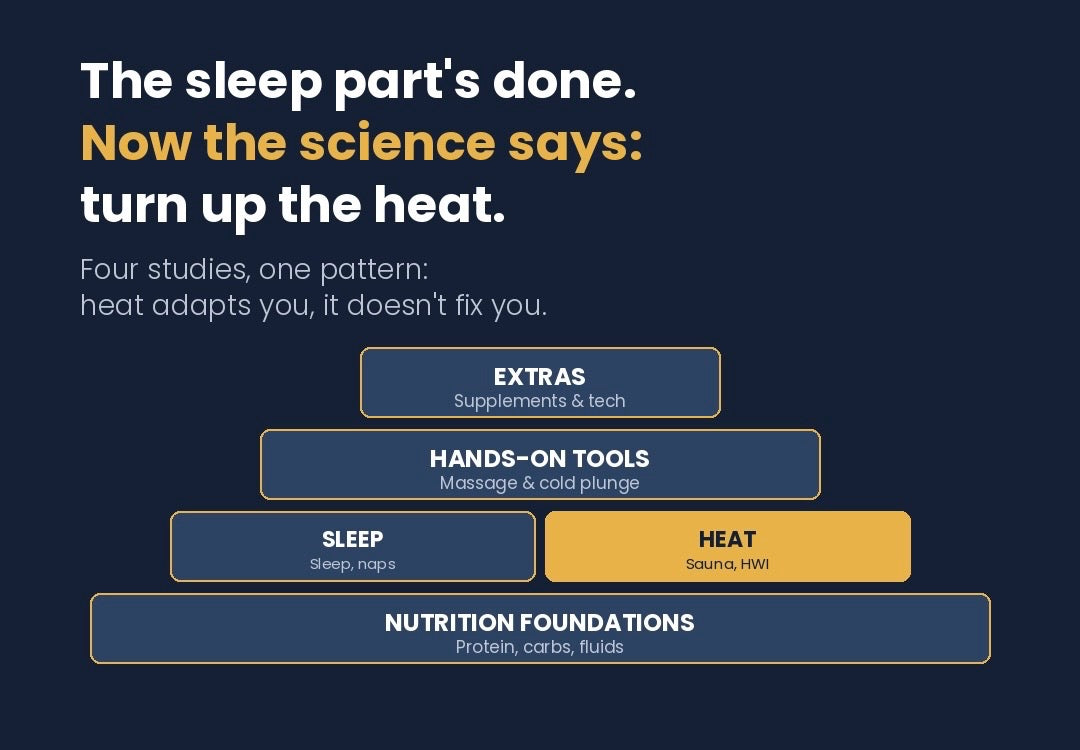
We’ve covered the foundation of the Recovery Pyramid: nutrition.
Now comes the part where you do…nothing. Like, nothing at all. Hard concept to grasp for a few of us...*coughcoughBENcoughcough...
Seriously. Go to bed.
Sleep might not have the novelty of a cold plunge, massage gun, sauna session or the latest recovery wearable, but when it comes to supporting recovery and performance, few tools have as much evidence behind them.
And for athletes, getting “enough” sleep probably means more than you think.
The Target: 8–10 Hours
The consensus recommendation for athletes is roughly 8–10 hours of sleep per night.
That’s not necessarily eight to 10 hours in bed scrolling Instagram. We’re talking about giving your body a legitimate opportunity to sleep, recover and adapt to the work you’re asking it to do.
And there’s a pretty substantial gap between what athletes need and what many actually get.
Research published in the International Journal of Sports Physiology and Performance found athletes reported needing about 8.3 hours of sleep to feel rested, while averaging only 6.7 hours. About 71% fell short of their perceived sleep need by at least an hour.
For an athlete stacking training, work, school and life, that deficit can add up quickly.
Why Sleep Matters for Recovery
Training is only half of the equation. You create the stimulus during the workout. Your body actually adapts afterward, and insufficient sleep can interfere with that process.
One study found that five consecutive nights of only four hours of sleep reduced myofibrillar protein synthesis by nearly 20%. In other words, you can nail the training and nail the protein shake afterward, but consistently shortchanging sleep may still compromise part of the adaptation you’re chasing.
That’s why we put sleep near the base of our Recovery Pyramid.
It isn’t an “extra.” It’s part of the program.
Had a Bad Night? Use the Nap Rescue
Of course, perfect sleep every night isn’t realistic.
Early flights happen. Kids wake up. Work runs late. Sometimes you just stare at the ceiling the night before a race wondering why on Earth you suddenly forgot how to sleep.
That’s where naps can become useful.
Research suggests a 20–30 minute nap following a short night can reduce perceived effort and improve subsequent exercise performance.
Think of it as a rescue strategy rather than a replacement for consistently good nighttime sleep.
If you slept poorly and have an important afternoon or evening training session, a short nap may be one of the simplest performance interventions available to you.
Before a Big Race? Bank It Early
Here’s another reason not to panic when you sleep terribly the night before a race:
You can do some of the work ahead of time.
Research examining sleep extension found that after athletes spent several nights increasing their sleep opportunity to roughly 8.5 hours, performance during a 60-minute cycling time trial improved by around two minutes compared with habitual sleep of roughly seven hours.
Interestingly, perceived effort was similar.
They were simply faster.
That makes sleep banking particularly useful before a race, competition or major training session. Rather than obsessing over getting the “perfect” night of sleep immediately beforehand, prioritize several strong nights leading into it.
Race week recovery starts before race eve.
Sleep and Injury Risk
Sleep may also play a role in keeping athletes healthy enough to train consistently.
A 2025 study following 425 runners for 12 months found poor sleepers were 1.78 times more likely to report an injury.
That doesn’t mean poor sleep automatically causes an injury. Injury risk is complex, and observational research can’t establish that kind of simple cause-and-effect relationship.
But it adds to a growing picture: sleep affects far more than whether you feel tired the next morning.
Training quality, recovery, adaptation and potentially injury risk are all part of the equation.
The Sleep Prescription
So what does this actually look like?
For most athletes, the practical playbook is pretty simple:
- Aim for 8–10 hours of sleep per night
- Use a 20–30 minute nap as a rescue strategy after a short night, particularly before an important later-day session
- Bank sleep before major races or training blocks by increasing sleep opportunity for several nights beforehand
- Treat sleep like part of your training plan — not whatever time happens to be left over after everything else
There are endless products designed to help athletes recover.
Some are useful. Some aren't. And we’ll get to plenty of them as we continue climbing the Recovery Pyramid.
But after you’ve fueled and hydrated properly, one of the best recovery interventions available is also one of the simplest.
Put the phone down. Turn the lights off. Go to bed.
Next week, we’re turning up the temperature: sauna, hot-water immersion and what the research actually says about heat as a recovery tool.