Recovery usually makes us think about cooling down.
Ice baths. Cold showers. Air conditioning. Anything that gets body temperature back toward normal after a hard training session.
But when heat is used deliberately and repeatedly, the opposite approach may create adaptations that make endurance athletes more resilient.
In Part III of our Recovery Pyramid series, Eric Zaltas, MS, IOC Diploma in Sports Nutrition, takes a look at the evidence behind post-exercise heat exposure — particularly sauna and hot-water immersion (HWI) — and where it actually belongs in an athlete's recovery strategy.
The key distinction is important:
Heat isn't necessarily a recovery tool for today. It's a training tool that may help you adapt for tomorrow.
Heat Stress Creates an Adaptation Signal
Training already challenges the body's ability to regulate temperature. Add controlled heat exposure after exercise, and you can extend that thermal stimulus without adding more mechanical load to the muscles and joints.
Over repeated exposures, the body begins adapting.
One study published in Frontiers in Physiology found that just six days of post-exercise hot-water immersion lowered resting core temperature in endurance-trained athletes.
That's one of the hallmarks of heat acclimation: the body becomes better prepared to deal with thermal stress before exercise even begins.
Other commonly observed heat adaptations can include changes in sweating response, cardiovascular strain and plasma volume — all of which can matter when you're trying to maintain performance as conditions get hotter.
But the benefits may not stop when the temperature drops.
The Number: 32% Longer to Exhaustion
One of the classic studies in this area examined trained runners who added post-exercise sauna bathing to their normal training.
After three weeks, the athletes improved their run time to exhaustion by 32% compared with their pre-sauna performance.
Researchers also found an increase in blood volume, including plasma volume.
That doesn't mean three weeks in the sauna magically makes an athlete "32% faster." Time-to-exhaustion testing is very different from a race or time trial.
But the result illustrates something much more useful: repeated post-exercise heat exposure can produce meaningful physiological adaptations in already-trained endurance athletes.
The sauna isn't replacing training.
It's extending the stimulus created by it.
And It May Help Outside the Heat
Heat acclimation obviously makes sense before a hot race. More interesting is the possibility that some adaptations may translate to performance in cooler conditions, too.
Research published in the European Journal of Applied Physiology found that three weekly post-run sauna sessions produced changes associated with improved performance in both hot and temperate running conditions.
Again, the point isn't that every athlete should immediately start sitting in a sauna after every workout.
It's that heat exposure can function as a legitimate component of endurance training rather than simply something athletes tolerate when summer arrives.
And newer research is expanding that conversation even further.
Heat Training Meets Altitude
A 2026 study published in Experimental Physiology investigated six weeks of post-exercise hot-water immersion and found improvements in performance at altitude alongside an increase in hemoglobin.
That's especially interesting because hemoglobin is central to oxygen transport — one of the major physiological constraints athletes encounter as elevation increases.
Heat exposure and altitude exposure are not interchangeable, and sitting in hot water isn't suddenly an altitude camp.
But the finding adds to the evidence that repeated thermal stress can create systemic adaptations extending beyond simply becoming more comfortable in hot weather.
The Most Important Caveat: Heat Isn't a Quick Recovery Hack
This is where heat can get misunderstood.
If you crushed a workout yesterday and feel terrible today, jumping into a sauna isn't necessarily going to "fix" the damage.
The strongest evidence here comes from repeated exposure over days and weeks.
Think about heat the same way you think about training.
One interval workout doesn't create fitness. One long run doesn't build endurance. And one sauna session doesn't create heat adaptation.
The benefit comes from the accumulated stimulus.
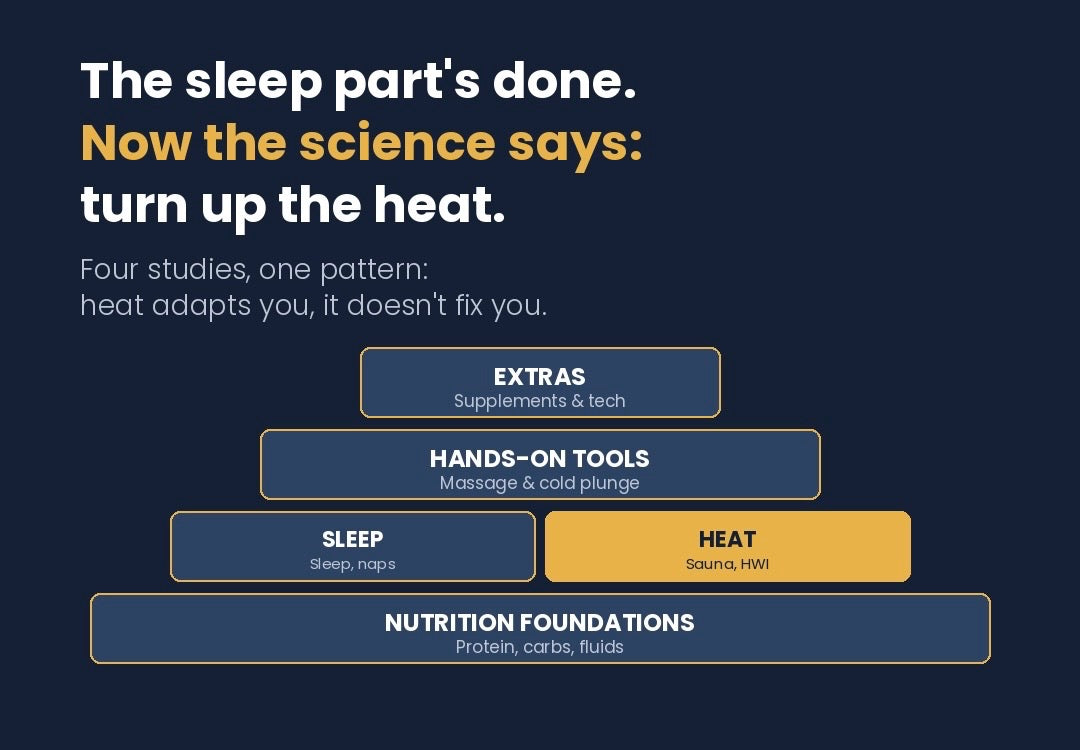
That's why heat sits alongside sleep in the Addra Recovery Pyramid rather than underneath it. Nutrition remains the foundation. Sleep remains essential. Heat can then be layered onto those fundamentals when it serves the athlete's larger training goals.
How to Put the Research Into Practice
For endurance athletes interested in incorporating heat, a practical starting point is 20–30 minutes of sauna or hot-water immersion soon after exercise, approximately three times per week.
Post-exercise timing is useful because core temperature is already elevated, allowing the athlete to extend the thermal stimulus rather than starting from baseline.
Consistency matters more than chasing one heroic session. Several of the studies highlighted here used interventions lasting multiple weeks, while measurable adaptations have also been observed after shorter consecutive-exposure protocols.
And there's one major consideration that shouldn't be overlooked:
Hydration.
Exercise already reduces body water and plasma volume through sweat. Moving directly into a hot environment increases that stress further.
Go into post-training heat exposure with a hydration plan, replace fluids and electrolytes appropriately, and remember that more heat isn't automatically better. Heat illness is not an adaptation strategy.
The Bottom Line
Heat belongs in the Recovery Pyramid — but perhaps not for the reason its placement might suggest.
It's less about recovering from the session you just completed and more about adapting to the training you're already doing.
Repeated sauna or hot-water immersion may improve thermoregulation, expand blood volume, support endurance performance and potentially contribute to adaptations that matter in temperate conditions and at altitude.
The formula isn't complicated:
Train. Apply a controlled heat stimulus. Rehydrate. Repeat consistently.
Just don't mistake the extra layer for the foundation underneath it.
Nutrition and sleep still do the heavy lifting.
Next up in the Recovery Pyramid: hands-on tools — massage, cold plunges, and what actually moves the needle.
References
Scoon GS, Hopkins WG, Mayhew S, Cotter JD. Effect of post-exercise sauna bathing on the endurance performance of competitive male runners. Journal of Science and Medicine in Sport. 2007.
Zurawlew MJ et al. Post-exercise hot water immersion induces heat acclimation and improves endurance exercise performance in the heat. Frontiers in Physiology. 2018.
Kirby NV et al. Post-exercise sauna bathing and endurance adaptations. European Journal of Applied Physiology. 2021.
Rodrigues et al. Post-exercise hot-water immersion, hemoglobin and altitude performance. Experimental Physiology. 2026.
Ahokas et al. Post-exercise heat exposure and recovery considerations. Sports Medicine – Open. 2025.
Suggested tags: Science Wednesday, Recovery, Heat Training, Sauna, Hot Water Immersion, Endurance Training, Endurance Athletes, Sports Science, Recovery Pyramid, Performance