If you follow professional cycling, you’ve probably seen it:
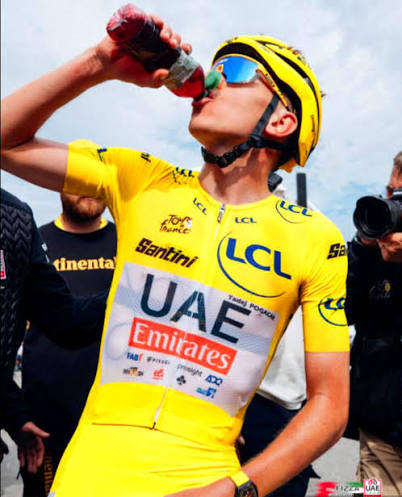
A rider finishes a brutal stage, gets off the bike and soon has a bottle of dark-red tart cherry juice in hand. Tadej Pogačar has been photographed drinking it after Tour de France stages, and tart cherry products have become increasingly common across the professional peloton.
That makes for compelling marketing. It does not, however, make for compelling evidence.
Professional use is influenced heavily by team nutrition partnerships, and tart cherry is typically just one component of a much larger recovery strategy. So rather than asking whether the pros use it, the better question is: What happens when researchers actually test it?
What is tart cherry?
Most research has focused on Montmorency tart cherries, typically consumed as juice or concentrated juice.
Tart cherries contain high concentrations of polyphenols, including anthocyanins. These compounds have antioxidant and anti-inflammatory properties and have been proposed to influence inflammation partly through COX-1 and COX-2 pathways — enzymes also targeted by NSAIDs.
That biological rationale has helped tart cherry develop a reputation as a recovery supplement, particularly for reducing muscle soreness after hard exercise.
But the latest research complicates that story.
What does the latest evidence show?
A 2026 systematic review and meta-analysis published in Sports Medicine - Open pooled 19 trials involving 385 trained athletes.
One of the clearest findings was improved recovery of maximal voluntary contraction, or MVC — essentially a measure of an athlete’s ability to produce force. Tart cherry supplementation significantly improved MVC recovery at each measured time point.
Researchers also found reductions in C-reactive protein, or CRP, a commonly measured marker of inflammation, through 48 hours of recovery.
Those are legitimate findings.
But there’s an important caveat: the results varied substantially among studies.
Heterogeneity was high — roughly 69% to 93% for several outcomes — and sensitivity analyses showed that some statistically significant results disappeared when researchers removed a single influential study.
The certainty of the evidence therefore ranged from very low to moderate.
In other words: there appears to be a signal, but it is nowhere near a slam dunk.
The surprising part: muscle soreness
This is where tart cherry gets especially interesting.
Despite soreness reduction being one of the primary reasons athletes buy tart cherry products, the meta-analysis found no significant pooled effect on delayed-onset muscle soreness (DOMS).
Researchers also found no significant pooled effects for creatine kinase, IL-6, TNF-alpha or range of motion.
That doesn't mean tart cherry never reduces soreness. Individual studies have found benefits. It means that when the available evidence in trained athletes is combined, the effect isn't sufficiently consistent to establish a clear overall benefit.
The study behind the reputation
One frequently cited study helps explain how tart cherry earned its recovery reputation in the first place.
In 2010, researchers studied 54 runners participating in the Hood to Coast relay. Each covered roughly 26 kilometers over a 24-hour period.
Participants consumed either tart cherry juice or placebo twice daily for seven days before the event and on race day.
Both groups experienced more pain after racing — but the increase was dramatically smaller in the tart cherry group. Pain increased about 12 mm on a 100-mm scale with tart cherry versus 37 mm with placebo.
It was a striking result.
It was also one relatively small study, and importantly, its outcome was pain — not recovery of muscular strength. More than 15 years later, the larger body of evidence paints a considerably more complicated picture.
How is tart cherry actually used?
Across the research, protocols vary, but a common approach is approximately two servings per day, often equivalent to around 30 mL of concentrate or 8–12 ounces of juice per serving.
Supplementation generally begins four to seven days before a major competition or demanding training bout and continues for roughly two to four days afterward.
That makes tart cherry different from something like caffeine. It isn't necessarily something you take five minutes before a workout and expect to feel.
If there is a benefit, it appears more likely to emerge from repeated supplementation surrounding a period of unusually high physical stress.
Is it worth it?
Possibly — but put it in the right place in your recovery hierarchy.
The latest evidence suggests tart cherry may provide a modest benefit for strength recovery and some markers of inflammation. The evidence for reducing the muscle soreness athletes often buy it for is considerably weaker.
There are also practical considerations. Juice products can contain substantial amounts of sugar, particularly if additional sugar has been added, so check the label. Tart cherry concentrate can also be relatively expensive.
For most athletes, tart cherry belongs near the top of the recovery pyramid, not at its foundation.
Adequate carbohydrate and protein intake, hydration, sufficient total calories and — above all — sleep remain much bigger priorities.
Once those are handled?
Tart cherry may be worth experimenting with around particularly demanding races or training blocks.
Just don't mistake seeing it in the hands of the yellow jersey for proof that you need it in yours.
Science Wednesdays takeaway: Tart cherry has a plausible mechanism and some evidence for improved strength recovery and reduced CRP. But the overall evidence remains inconsistent, and its famous soreness-reduction effect is much less convincing when the studies are pooled.
References:
Daab et al. Sports Medicine - Open, 2026.
Kuehl et al. Journal of the International Society of Sports Nutrition, 2010.