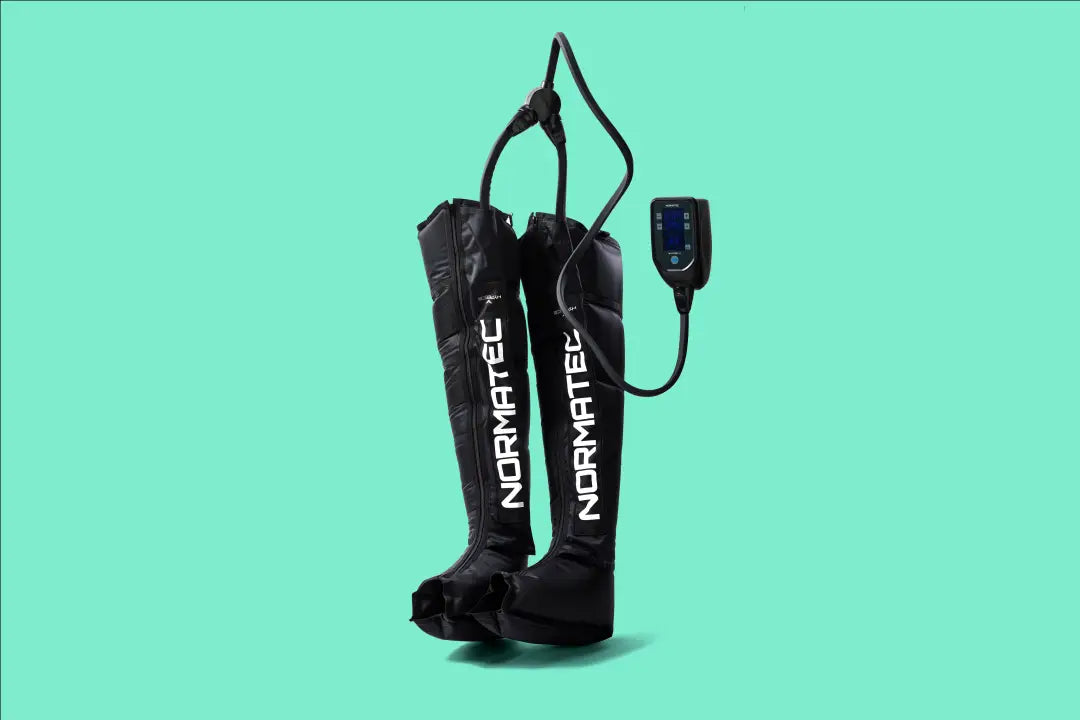
Spend enough time around runners, cyclists or triathletes and you’ll eventually see someone lying on a couch with their legs zipped into a pair of giant inflatable boots.
Compression boots — technically known as intermittent pneumatic compression, or IPC — have become one of the most recognizable recovery gadgets in endurance sports.
The pitch makes intuitive sense: Put your legs inside air-filled sleeves, rhythmically squeeze them from the feet upward and help move blood and fluid through tired muscles.
But there’s an important distinction between something that feels like recovery and something that measurably accelerates physiological recovery.
So, what do compression boots actually do?
What pneumatic compression is
Unlike traditional compression socks or tights, which apply relatively steady pressure, pneumatic compression boots repeatedly inflate and deflate.
Different chambers generally compress the legs sequentially, creating cycles of pressure from the lower leg upward.
The proposed mechanism is that this cyclic compression assists venous and lymphatic return, potentially reducing swelling and helping move fluid through the limbs.
That mechanism is plausible. But a plausible mechanism doesn't automatically translate into faster recovery or better athletic performance.
And that’s where the research gets interesting.
What does the research actually show?
A 2024 systematic review and meta-analysis published in Biology of Sport examined 17 studies involving 319 participants.
Researchers found trivial-to-small benefits for muscular function, trivial-to-moderate effects on pain and soreness, and highly variable results for markers of muscle damage. The authors concluded that IPC may have potential as a recovery tool, particularly for reducing perceived soreness — but emphasized that the evidence remains limited. PubMed
A larger subsequent systematic review and meta-analysis pooled 27 studies and 554 healthy adults.
Its conclusion followed a similar pattern: IPC produced a small but statistically significant reduction in soreness and pain, while results across many other recovery measures were inconclusive. Colab
That distinction matters.
The most consistent benefit of compression boots appears to be feeling less sore — not necessarily repairing damaged muscle faster.
The placebo problem
Recovery research has an unusually difficult problem: You know when your legs are being squeezed by inflatable boots.
That makes blinding participants difficult.
In the 2024 review, only six of the 17 included studies used a placebo condition, and none blinded assessors to treatment. The authors specifically cautioned that results should therefore be interpreted carefully. Termedia
That doesn't mean a reduction in soreness is imaginary or useless.
Feeling better matters to an athlete.
But it does mean we should be careful about jumping from “my legs feel better” to “my muscles have recovered faster.”
Those aren't necessarily the same thing.
What about endurance athletes?
This is where the evidence becomes even less exciting.
A 2021 review specifically examined IPC following prolonged exercise in endurance-trained athletes. It included evidence from marathoners, ultramarathoners, triathletes and cyclists.
The review found that IPC was not effective at reducing exercise-induced muscle damage in endurance athletes. It did, however, acknowledge that the boots may provide short-term relief from delayed-onset muscle soreness. PubMed
In other words, if you're a runner or triathlete hoping that 30 minutes in compression boots will somehow erase yesterday's long run, the evidence doesn't support that claim.
If you simply want your beat-up legs to feel a little better?
That's much more defensible.
Are boots better than compression garments?
We don't have much direct evidence.
One 2018 crossover study compared pneumatic compression with a continuously worn compression sleeve during recovery from delayed-onset muscle soreness.
The pneumatic device performed better on several measures, including pain, range of motion and some measures of swelling. PubMed Central (PMC)
Sounds impressive — until you look at the study population.
There were eight participants.
They were college students.
And researchers induced soreness in the elbow flexors, not the legs.
Interesting? Absolutely.
Proof that runners should spend hundreds of dollars on recovery boots instead of wearing compression socks? Not remotely.
How are compression boots typically used?
Across the studies analyzed in the 2024 review, protocols of roughly 20-30 minutes at around 80 mmHg were among the most commonly used approaches. PubMed
Importantly, this is a post-exercise recovery intervention, not something intended to be used during training.
That also doesn't mean 80 mmHg for 30 minutes has been established as a magical optimal dose. It simply reflects what has commonly been studied.
So, are compression boots worth it?
That depends on what you're expecting them to do.
If you're buying compression boots because you expect them to dramatically accelerate muscle repair, eliminate exercise-induced muscle damage or produce a measurable performance advantage the next day, the research isn't particularly convincing.
If you're using them because you enjoy the sensation, they encourage you to sit down and recover, and your legs feel less sore afterward?
There is legitimate evidence supporting that use.
And that's an important distinction in sports science.
A recovery tool doesn't need to rebuild muscle fibers at warp speed to have value. But we also shouldn't turn a modest effect on perceived soreness into something the research hasn't demonstrated.
The short version
Compression boots appear to help athletes feel a little less sore.
They have not consistently been shown to meaningfully reduce muscle damage or improve subsequent performance, and endurance-specific evidence is particularly limited. PubMed
So use them if you like them.
Just don't confuse feeling recovered with proof that you've recovered faster.
And before spending $1,000 chasing marginal recovery gains, remember the boring stuff still does most of the heavy lifting:
Sleep. Food. Hydration. Smart training. Time.
The boots can come after that.