Tech is a big tier of the Recovery Pyramid, so we’re breaking it up. There are recovery compression devices (like Theraguns, for instance), electrical muscle stimulation (EMS), TENS, sleep technology - the list goes on and on. For our first stop, we'll be exploring red light therapy, also called photobiomodulation (PBMT).
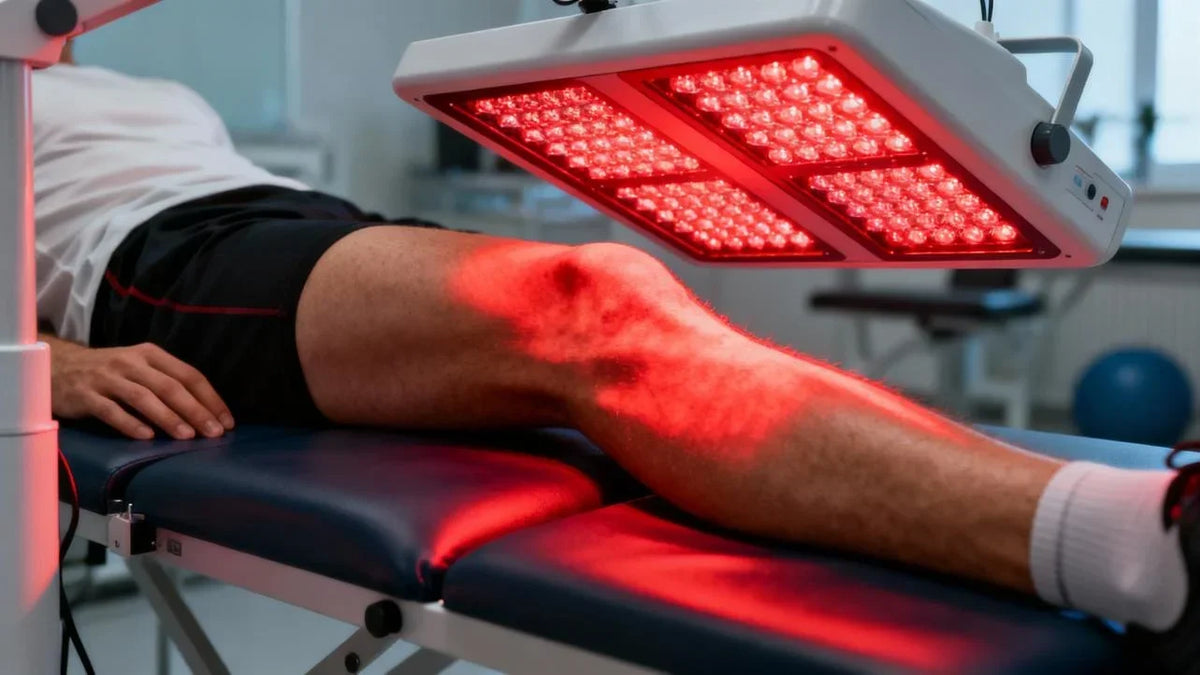
PBMT uses red or near-infrared light delivered by an LED panel or laser. It’s been a fixture in recovery rooms for years, with proposed effects on cellular energy production and muscle recovery.
But does it actually make athletes faster?
The latest evidence
A 2024 meta-analysis pooled results from 34 randomized trials and found a real, moderate effect.
There’s an important catch: “endurance” in much of this research doesn’t mean sustained aerobic exercise like running or cycling. Researchers often measured repetitions or seconds to failure in a single muscle, such as during a knee-extension test.
Similar improvements appeared in measures of strength recovery and muscle-damage markers.
The subgroup analysis added another wrinkle. Benefits appeared in both sedentary participants and athletes, but not in recreationally active exercisers. For the ADDRA audience, the athlete subgroup is the more relevant comparison — but it still doesn’t answer the race-performance question.
What happens when researchers actually test runners?
A separate 2024 meta-analysis examined 12 studies involving runners, while another dose-response trial tested three PBMT doses reaching as high as 1,260 joules.
Both studies looked at acute, same-day performance rather than recovery in the following days, yet neither found an improvement in running performance.
That distinction matters. Based on the evidence so far, PBMT looks more promising for recovery than race-day speed.
How PBMT may work
Red and near-infrared wavelengths can penetrate beyond the skin and reach underlying tissue.
One proposed target is cytochrome c oxidase, an enzyme involved in mitochondrial energy production. Under certain conditions, nitric oxide can interact with the enzyme and inhibit its activity. One proposed PBMT mechanism is that light alters this interaction, potentially supporting mitochondrial function and ATP production.
The mechanism remains an active area of research, so it’s better understood as a plausible explanation than a settled one.
How much red light?
With PBMT, time alone isn't the dose. Light energy is measured in joules.
Research protocols have commonly used roughly:
- 20–60 J for a small muscle group
- 60–300 J for a large muscle group
Because devices differ in power output, the treatment time required to reach those doses varies. That makes the manufacturer’s specifications important — five minutes with one device isn't necessarily equivalent to five minutes with another.
When should athletes use it?
Studies have tested PBMT immediately before exercise and as far as six hours beforehand.
Given that same-day endurance-performance benefits haven't consistently appeared, athletes interested primarily in recovery may have more reason to use PBMT in connection with demanding training sessions rather than treating it as a last-minute race-day intervention.
And there’s another limitation: wavelength, device, treatment location and dose vary considerably between studies. There still isn't one universally established PBMT protocol.
So, does it earn its shelf space?
For athletes, the evidence is more compelling for supporting recovery than directly improving race-day performance.
Trials to date have generally reported few adverse effects, but the hardware isn't cheap. A device designed to treat an individual muscle group can cost roughly $200–$600.
So PBMT belongs near the top of the Recovery Pyramid for a reason: it’s a potential marginal gain, not a foundation. Nail nutrition, sleep and training first. Then decide whether the evidence — and the price tag — earn it a spot in your recovery routine.
Next week, we’re staying in the gadget aisle and asking the same question of another recovery technology: does it earn its shelf space?
Sources: Li et al., Lasers in Medical Science (2024); Leal-Junior et al., Brazilian Journal of Physical Therapy (2019); International Journal of Exercise Science / Lasers in Medical Science (2024).